
How Suspended Fireplaces Transform a Room — and What to Budget
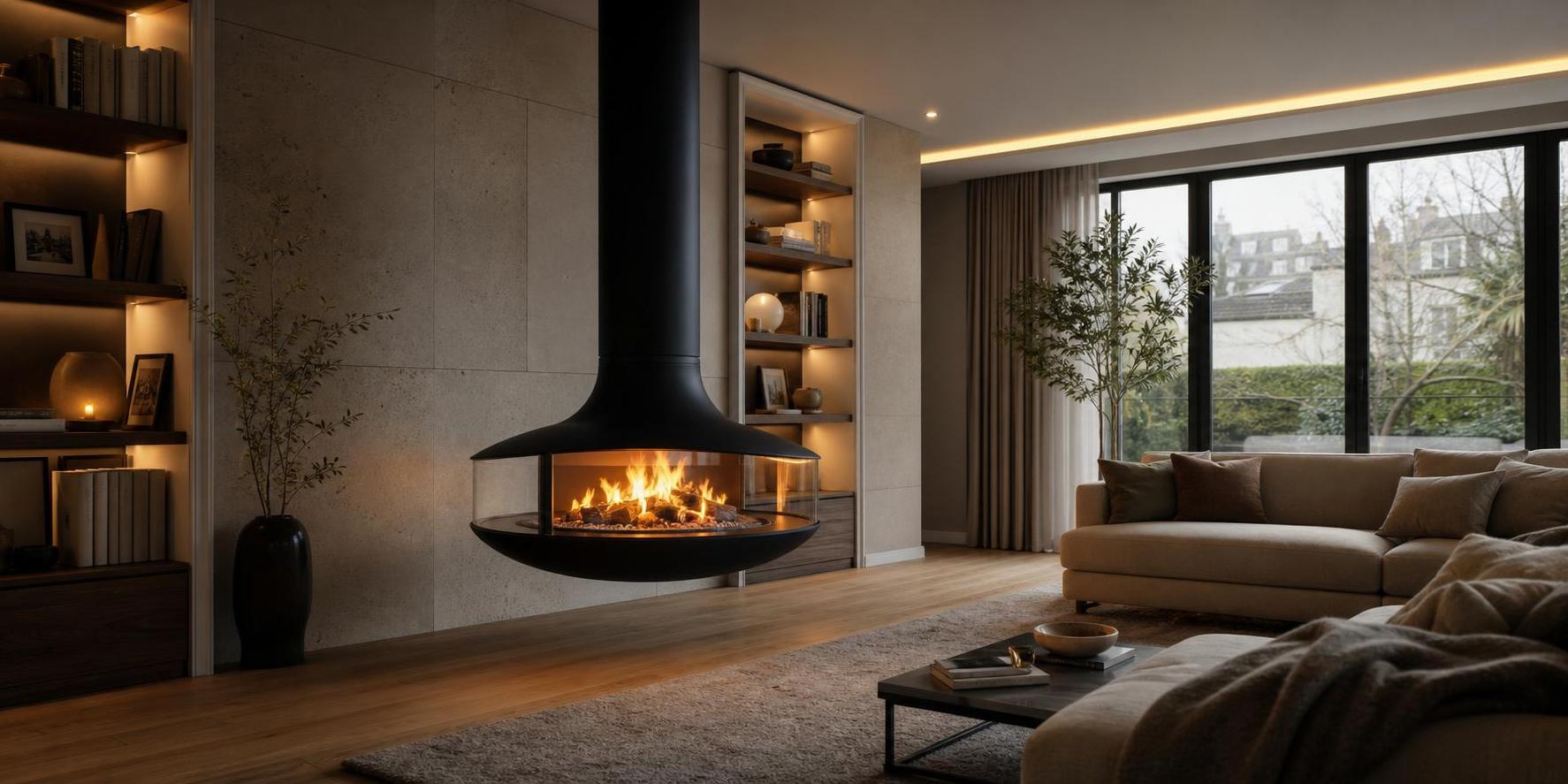
Suspended fireplaces are the most dramatic way to add fire to an open-plan space. Here's what they cost in South Africa, how installation works, and which fuel type suits your home.
Suspended fireplaces do something no wall-mounted or freestanding unit can replicate — they hang in mid-air, suspended from the ceiling on a polished steel flue, commanding a room from every angle. Whether you’re drawn to the sculptural drama of a cone-shaped wood burner or a sleek cylindrical gas model floating above a polished concrete floor, suspended fireplaces have become the statement piece of choice for open-plan South African homes. But they’re not an impulse buy. Getting the fuel type, size, and installation spec right makes the difference between a fireplace that transforms your living room and one that disappoints.

This guide covers everything you need to make a confident decision — from fuel types and realistic wall-mounted and suspended fireplace options to SA price ranges, installation requirements, and the questions buyers most often get wrong.
What Makes Suspended Fireplaces Different?
The defining feature is the flue: a stainless-steel pipe that drops straight down from your ceiling, with the firebox suspended below it like a pendant light. Unlike a built-in fireplace recessed into a wall or a freestanding unit sitting on the floor, a suspended model occupies the centre or a feature zone of a room, giving you a near-360° view of the fire.
From a heating standpoint, this configuration offers one practical advantage: heat radiates outward in multiple directions simultaneously rather than being directed from a single wall. In the large, open-plan living and dining areas typical of newer Cape Town homes, this even distribution can be more effective than a single-wall installation. The trade-off is that a suspended fireplace requires ceiling anchor points strong enough to carry 60–120 kg, a penetration through your ceiling and roof (which must be properly waterproofed), and — for wood and gas models — professional installation with a Certificate of Compliance.
For context on how suspended models compare with built-in and freestanding alternatives, our freestanding vs built-in fireplace guide walks through the key structural and heating differences.
Suspended Fireplaces by Fuel Type
The fuel you choose affects running cost, maintenance, and how much real heat output you’ll get. Here’s how each option stacks up.
Wood-Burning
Wood-burning suspended fireplaces are the most visually dramatic and typically the most powerful heat source. A properly sized closed-combustion firebox in the 10–16 kW range can warm a large open-plan living and dining area without any electricity — a real advantage during load-shedding. These units are almost always closed-combustion designs, meaning they draw controlled air through a dedicated vent rather than pulling warm room air up the flue. The result is better efficiency, lower wood consumption, and significantly less creosote than an open fire. Reputable European manufacturers such as RAIS have been engineering these units for decades and their cone and cylinder designs remain the benchmark.
Running cost depends on firewood quality and consumption. Expect to burn 20–30 kg of dry hardwood per weekend in winter — at roughly R12–R15 per kg for delivered Cape Town firewood, that’s R1,800–R4,500 per season for regular weekend use.
Gas
Gas suspended fireplaces ignite instantly, allow precise heat control, and leave no ash. They work on LPG or natural gas and are the cleaner daily-use option. The limitation: most gas suspended models top out at 5–8 kW, which suits a bedroom, dining room, or smaller lounge rather than a large double-volume space. If you’re primarily after aesthetics rather than a primary heat source, gas makes a compelling case. Our gas vs wood-burning fireplace comparison covers running costs in detail.
Ethanol (Flueless)
Bio-ethanol suspended fireplaces burn clean and require no flue at all — the combustion produces only water vapour and CO₂. This makes them genuinely flexible: you can position one anywhere with sufficient ventilation. The catch is heat output, which is typically 1.5–3 kW — enough to add ambiance and a little warmth to a small room, but nowhere near enough to be a primary heat source. Think of an ethanol suspended fireplace as a design feature, not a heating appliance. They’re also the most affordable option at entry level.
What Suspended Fireplaces Cost in South Africa
Suspended fireplaces sit at the premium end of the market. Here’s a realistic breakdown of what different budgets deliver, before installation:
- R15,000–R30,000: Entry-level cone or bowl designs, typically steel with standard colour options, small to medium firebox (8–10 kW for wood, 4–6 kW for gas). Basic single-wall stainless flue included or available as an add-on. Functional and stylish, but limited customisation.
- R30,000–R60,000: Mid-range from quality European or South African brands. Larger fireboxes (10–16 kW), better steel grade, multiple colour finishes, improved air control. Most popular price bracket for open-plan homes.
- R60,000–R120,000+: High-spec design pieces with custom powder-coat finishes, double-sided glass, remote-controlled air regulation, or bespoke sizing. If you’re furnishing a double-volume living area or building a statement interior, this is the range to consider.
Installation adds significantly to the total. For suspended fireplaces, the flue must penetrate your ceiling and roof — which involves extra materials, a flashing kit, waterproofing, and labour. Typical installation cost: R8,000–R20,000 depending on ceiling height, roof type (IBR sheet vs tile vs thatch), and whether insulated twin-wall flue is required (it almost always should be at ceiling penetrations). On coastal Western Cape properties within 1–2 km of the ocean, specify 304-grade marine stainless steel as a minimum — salt air corrodes standard stainless within a few years at that proximity. For a full breakdown of what installations run in South Africa, read our fireplace installation cost guide.
Installation: What’s Actually Involved
Installing a suspended fireplace is a multi-trade job. The unit itself must hang from a structural ceiling joist, beam, or purpose-built steel bracket — not from plasterboard alone. Once the anchor is confirmed, the flue runs vertically up through the ceiling and out of the roof, which requires:
- A properly dimensioned roof penetration with a stainless steel flashing and cowl
- Insulated twin-wall flue for any section running through the ceiling cavity (to prevent heat transfer and condensation)
- Minimum clearances from combustible materials at the penetration point (governed by SANS 1283 for solid fuel, or SANS 10087 for gas)
- First-fire calibration and a Certificate of Compliance (COC) — required by most home insurers and by law for wood and gas appliances
Room height matters more with suspended fireplaces than with any other type. Most units are designed for ceiling heights of 2.7 m or more. At 3 m and above, the proportions are ideal and the exposed flue becomes a deliberate design element. In rooms below 2.5 m, the geometry rarely works — the unit hangs too low or the flue looks compressed. Factor this into your assessment early.
For a wider look at how suspended models sit within the full range of fireplace styles, browse our wall-mounted and suspended fireplaces range or read through our fireplace selection guide to compare all configurations side by side. If you’re also weighing up a double-sided option, our double-sided fireplaces range is worth exploring — several models can be specified as suspended configurations. And for the latest design directions, our look at current fireplace design trends covers how suspended and floating fireplaces fit into the broader shift toward minimalist, feature-led interiors.
Frequently Asked Questions About Suspended Fireplaces
Are suspended fireplaces safe?
Yes — when installed professionally to applicable standards. The key requirements are a structurally adequate ceiling anchor, a correctly specified and routed flue, compliant roof penetration, and proper clearance from combustibles. A COC from a registered fireplace installer is the standard confirmation that these requirements have been met, and most home insurers require it for wood and gas appliances.
What ceiling height do I need for a suspended fireplace?
Most manufacturers recommend a minimum of 2.7 m, with 3 m or more being ideal. Below 2.5 m, proportions become difficult and installation clearances may be insufficient. Your installer should confirm ceiling suitability during the site assessment.
Can I install a suspended fireplace on a thatched roof?
Yes, but it requires additional precautions — specifically a spark arrestor, extended flue clearance above the thatch surface, and compliance with SANS 10400-T. Thatch installations must be handled by an installer experienced with this roof type. It’s worth budgeting an additional R3,000–R8,000 for the upgraded flue specification and flashing.
How do I choose between a wood-burning and gas suspended fireplace?
If maximum heat output and load-shedding resilience are priorities, go wood-burning. If ease of use, clean operation, and daily convenience matter more than raw heat output, gas is the better fit. Ethanol suits buyers who want the look of a suspended fireplace without any flue work. A site assessment from our fireplace installation team can help you narrow this down based on your room dimensions and usage habits.
Ready to Plan Your Suspended Fireplace?
A suspended fireplace is one of the most impactful interior decisions you can make in an open-plan space — but it needs to be specced correctly for your ceiling height, roof type, and heating goals. Request a free fireplace installation quote and we’ll send a team member to assess your space, walk you through the right fuel type, and confirm whether your ceiling and roof can support the installation you have in mind.
Related Reading
- The Cost of Installing a Fireplace in South Africa
- Freestanding vs Built-In Fireplaces: Which Is Right for You?
- The Perfect Fireplace for Your Home
- Gas vs Wood-Burning Fireplaces
- Fireplace Design Trends
Related reading
- Can You Install a Fireplace in an Existing Home? Yes — Here's How
- Combustion Fireplace Installation: How It Works, Costs & Compliance
- Need it done professionally? See our fireplace installation in Cape Town service.
Planning this kind of work?
Call or WhatsApp with your suburb and photographs. Fire Flames can discuss your fireplace, braai or home project and quote.
Get A Quote →