
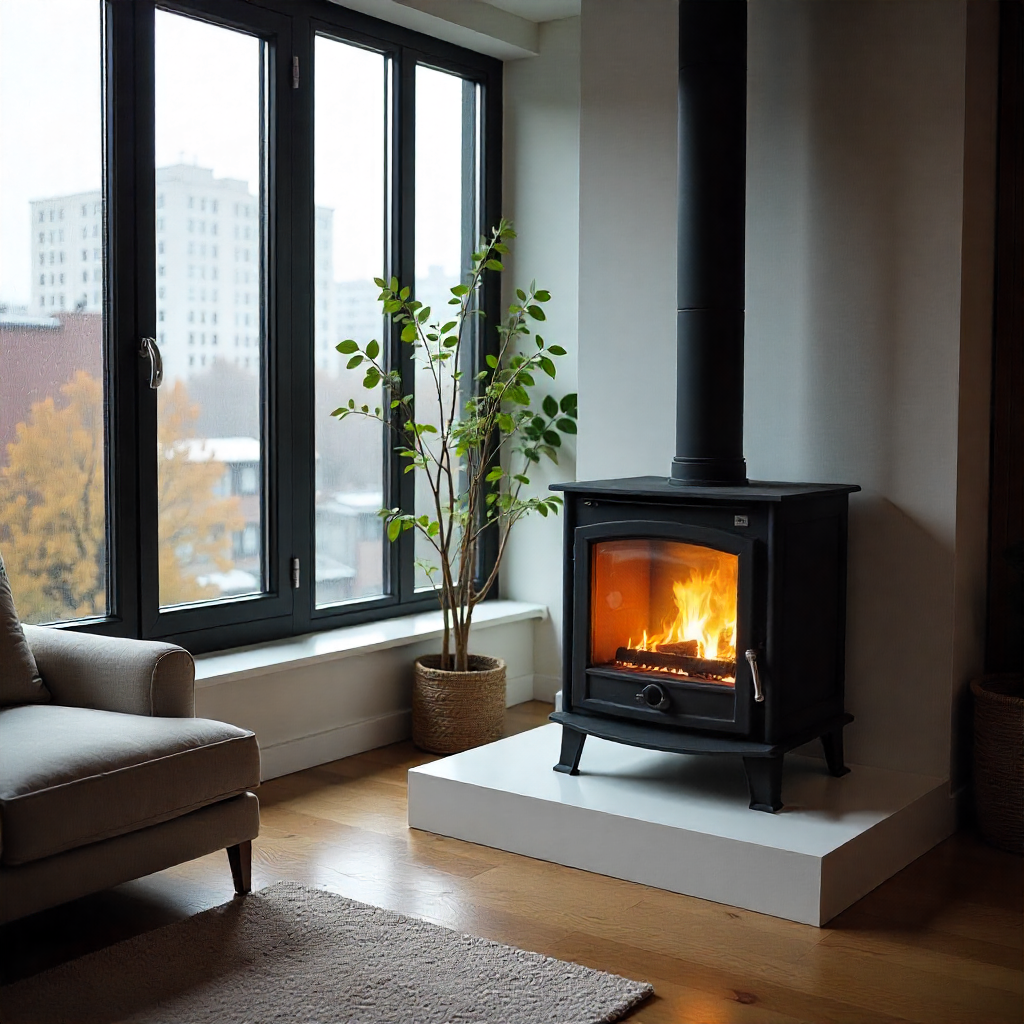

An indoor wood burning stove does something an electric heater simply cannot: it radiates deep, even heat from a real fire that warms walls, floors and people — not just the air around a coil. If you’ve been relying on electric panel heaters or a plug-in oil radiator to survive Cape Town winters, you’ll recognise the feeling of a room that’s warm near the heater and cold everywhere else. A properly sized wood stove changes that entirely. Explore our freestanding wood-burning fireplaces to see what’s available in South Africa right now.
South African winters are mild by global standards, but coastal humidity and the thermal mass of brick or plaster homes makes them feel colder than the thermostat suggests. A wood stove with a good efficiency rating solves this problem cleanly — without adding to the electricity bill during peak load-shedding hours.
How an Indoor Wood Burning Stove Actually Works
Most modern indoor wood burning stoves sold in South Africa are closed-combustion designs: fire burns in a sealed firebox behind a glass door, hot gases pass through a flue or chimney, and heat radiates outward through the cast iron or steel body. Unlike an open fireplace — which pulls warm room air up the flue and loses 60–80% of its heat to the outside — a quality closed-combustion stove converts 70–85% of the wood’s energy into usable room heat.
That efficiency gap is why most fireplace professionals now recommend a closed-combustion or slow-burn design over an open hearth. For the same volume of firewood, you get significantly more warmth — and far less smoke, creosote build-up and cleaning. If you’re weighing all your options, our guide on choosing between freestanding and built-in fireplaces breaks down the trade-offs clearly.
Freestanding vs Built-In: Which Indoor Type Fits Your Home?
This is the first real decision to make. Both are legitimate indoor wood burning options, but they suit different homes and budgets.
Freestanding stoves stand on legs or a base and connect to a flue pipe that runs through a wall or straight up through the ceiling. They’re easier to retrofit into existing rooms because you don’t need to build masonry around them. The trade-off is that they take up floor space and the flue pipe is visible. Browse our freestanding fireplace range for sizes from compact 5 kW bedroom models to 12–15 kW units that can heat a large open-plan living area.
Built-in stoves are set into a recess in the wall or an existing chimney breast. They look cleaner and more permanent — often a better fit if you’re renovating or building new. Our built-in fireplace inserts include options designed specifically to replace an old open fireplace, immediately turning a heat-wasting hearth into an efficient closed-combustion unit.
Neither is automatically better. If you rent, freestanding wins. If you’re doing a renovation and want a focal-point fireplace, built-in usually looks more polished. Read how to choose the perfect fireplace for your home for a fuller breakdown of factors beyond just style.
What kW Output Do You Actually Need?
Oversizing is the most common mistake buyers make. A 15 kW stove in a 20 m² bedroom will overheat the room within 30 minutes and force you to burn the stove at low smouldering output — which is exactly the condition that produces creosote. A rough rule used by most SA fireplace installers is:
- Small rooms (up to 25 m²): 4–6 kW — adequate for a bedroom or study
- Medium rooms (25–50 m²): 6–10 kW — typical living room in a Cape Town townhouse
- Large open-plan areas (50–80 m²): 10–15 kW — consider a double-sided unit or two stoves
Coastal homes (think Hermanus, Blouberg, Simons Town) with high humidity and sea-facing exposure often need 10–15% more output than the room size calculation suggests — the damp air absorbs heat quickly. Insulation matters too: a well-insulated modern home in Stellenbosch can get by with a smaller unit than a poorly insulated older home of the same floor area.
If you want a stove that does heavy lifting in a larger space, the Sentinel freestanding wood-burning fireplaces are worth looking at — the mid-range models hit the 8–12 kW sweet spot for most SA living rooms.
What Does It Cost to Buy and Install in South Africa?
Here’s a realistic bracket breakdown for a complete indoor wood burning stove purchase and professional installation in 2026:
- Entry-level (R12,000–R22,000): A basic steel freestanding stove with a single-skin flue pipe. Gets the job done for a small room or budget-conscious retrofit. Less refined airwash glass and shorter warranty.
- Mid-range (R25,000–R45,000): The sweet spot for most homes. Cast iron or quality steel construction, multi-air control, clear glass, professional-grade liner or twin-wall flue, Certificates of Compliance included. This is where most of our installations land.
- Premium (R50,000–R80,000+): Large output, designer aesthetics, premium glass, often a built-in or double-sided configuration. Built to last 20–30 years with minimal maintenance.
Installation labour, flue pipe, hearth protection and a Certificate of Compliance (CoC) typically add R6,000–R15,000 to the unit cost depending on complexity. For a full cost guide, read what fireplace installation costs in South Africa — it covers all the variables that shift the final number up or down.
Load-Shedding Survival: Why a Wood Stove Has a Real Edge
South Africa’s grid reliability has improved since 2024, but the memory of Stage 6 is fresh enough that off-grid heat still makes practical sense. An indoor wood burning stove operates entirely without electricity — no pump, no fan, no app. The fire burns, heat radiates. Full stop.
During a four-hour load-shedding block on a cold June evening in Cape Town, a wood stove keeps the room at temperature continuously. An electric heater cycles off the moment the power drops. For families with young children or elderly members, that’s not a minor comfort preference — it’s a meaningful safety consideration.
Wood fuel (kiaat off-cuts, rooikrans, kameeldoring) is widely available across the Western Cape. Dry hardwood burns hot, clean and long — rooikrans, in particular, is a locally sourced invasive species that’s legal to harvest and burns extremely well. The full range of fireplaces we carry is selected with SA fuel availability in mind.
5 Things to Check Before You Buy
Before committing to any indoor wood burning stove, run through these five checks:
- Does your home have or can it accommodate a flue? Most homes can, but double-check ceiling heights and roof type before ordering a unit. A professional fireplace installation assessment catches problems before they become expensive surprises.
- What’s the efficiency rating? Look for 70%+ thermal efficiency. Many imported stoves tested in European lab conditions don’t hit those numbers with SA wood species — ask specifically.
- Is a CoC included in the quote? A Certificate of Compliance is legally required for any fixed appliance installation in South Africa. Don’t accept a quote that doesn’t include it.
- What’s the glass airwash system like? A poor airwash system lets the glass soot over within a day of use. A good one keeps the glass clear for weeks between cleans.
- What are the warranty terms? Cast iron stoves from reputable brands typically carry 5–10 year structural warranties. Cheap imports often don’t.
Our freestanding vs built-in guide covers more of these technical details if you want to go deeper before making a decision.
Frequently Asked Questions About Indoor Wood Burning Stoves
Do I need a chimney for an indoor wood burning stove?
Not necessarily a traditional masonry chimney. Most freestanding stoves can be installed with a twin-wall insulated flue pipe that runs through an exterior wall or up through the ceiling and roof. This is standard practice in South Africa and costs less than building a full chimney. A quality twin-wall flue maintains the high flue temperatures needed for proper draft even in mild SA winters.
Is an indoor wood burning stove safe for families with young children?
Yes, with appropriate precautions. A closed-combustion stove with a spark-proof glass door is significantly safer than an open fire. The exterior body does get very hot — a safety guard or hearth rail is worth adding if you have toddlers. Keep a carbon monoxide detector near the stove and ensure annual chimney maintenance to prevent creosote build-up. The SANS 10087 standard covers safe installation specifications for solid fuel appliances in South Africa.
How much firewood will I get through in a season?
Running a 6–8 kW stove for 4–5 hours per evening through the Cape winter (May–August), expect to use roughly 1.5–2.5 cubic metres of dry hardwood per season. At current Western Cape firewood prices (R600–R1,200 per quarter-cord depending on species), that’s a full season’s warmth for R2,400–R4,800 — far less than running electric heaters for the same period.
Can I install an indoor wood burning stove in a rental property?
It depends on your lease agreement. Freestanding stoves are easier to argue as non-permanent fixtures if you use a through-wall flue kit. That said, most landlords who agree in writing will also require a professional installation with a CoC. Always get written permission before proceeding, and confirm who owns the stove at the end of the lease.
The Verdict
If your goal is reliable, cost-effective winter heat that works independently of the grid, an indoor wood burning stove is hard to beat. It heats a room evenly, uses locally available fuel, lasts decades with basic maintenance, and creates the kind of ambience a panel heater never will. The upfront cost is real, but most homeowners recoup it in reduced electricity bills within two to three winters.
Ready to find the right unit for your home? Get a free fireplace installation quote from our Cape Town team — we assess your space, recommend the right output, and handle everything from supply to CoC.